Peacebuilding & Mediation

Youth at the Helm: Empowering Young Mediators for Peace and Reconciliation in Bor South County

Strengthening youth leadership and community-based conflict resolution across Jonglei State

Bor South County, Jonglei State
June – July 2026
ifa · zivik Programme
12 June 2026

Project overview

The Invisible Women Inclusion Network (I-WIN), with support from the ifa (Institut für Auslandsbeziehungen e.V.) through the zivik Funding Programme and funding from the German Federal Foreign Office, is implementing the project “Youth at the Helm: Mediation and Reconciliation for Crisis Prevention in Bor South County.”

The initiative strengthens youth participation in peacebuilding, mediation and reconciliation while addressing the root causes of community conflict across six payams. It recognizes young people as critical actors in preventing violence, facilitating dialogue and promoting peaceful coexistence — through capacity building, community engagement, and the establishment of local peace structures for conflict prevention and early warning.

Key achievements

During the first two months of implementation, the project launched operations across all six target payams, completed a comprehensive baseline assessment covering 360 respondents, trained a full cohort of 80 youth mediators, and engaged 60 community representatives in the formation of local peace committees.

6
Payams with active operations
360
Respondents in the baseline assessment
80
Youth mediators trained
60
Community representatives engaged
2
Intensive five-day training sessions
6
Local peace committees being formed

Launching a Youth-Led Peace Initiative

The project was officially launched on 12 June 2026 during a stakeholder engagement meeting held in Bor Town. The launch brought together representatives from state and county government institutions, traditional authorities, women and youth leaders, civil society organizations, and humanitarian actors to introduce the project objectives and strengthen local ownership.

The event highlighted the importance of youth engagement in addressing recurring conflicts related to land, resource access, cattle migration, and community tensions. Local authorities pledged their support and emphasized the importance of strengthening grassroots mechanisms capable of addressing disputes before they escalate into violence.

The project launch strengthened collaboration among local authorities, community leaders, and young peace actors across Bor South County.
Understanding Community Conflict Through a Baseline Assessment

To ensure evidence-based implementation, I-WIN conducted a baseline assessment involving 360 respondents across the six target payams. The assessment examined conflict trends, community perceptions of peace structures, participation in peace processes, and opportunities for youth engagement in conflict prevention.

The study revealed that although peace structures already exist within many communities, they often face limitations in capacity, inclusiveness, and coordination. Land disputes, water access, grazing routes, and seasonal migration were identified as major drivers of local tensions. These findings now inform the design and sequencing of project activities.

360

respondents surveyed

across six payams

The baseline assessment provided vital evidence to guide youth-led mediation and reconciliation interventions.

Building a New Generation of Youth Mediators

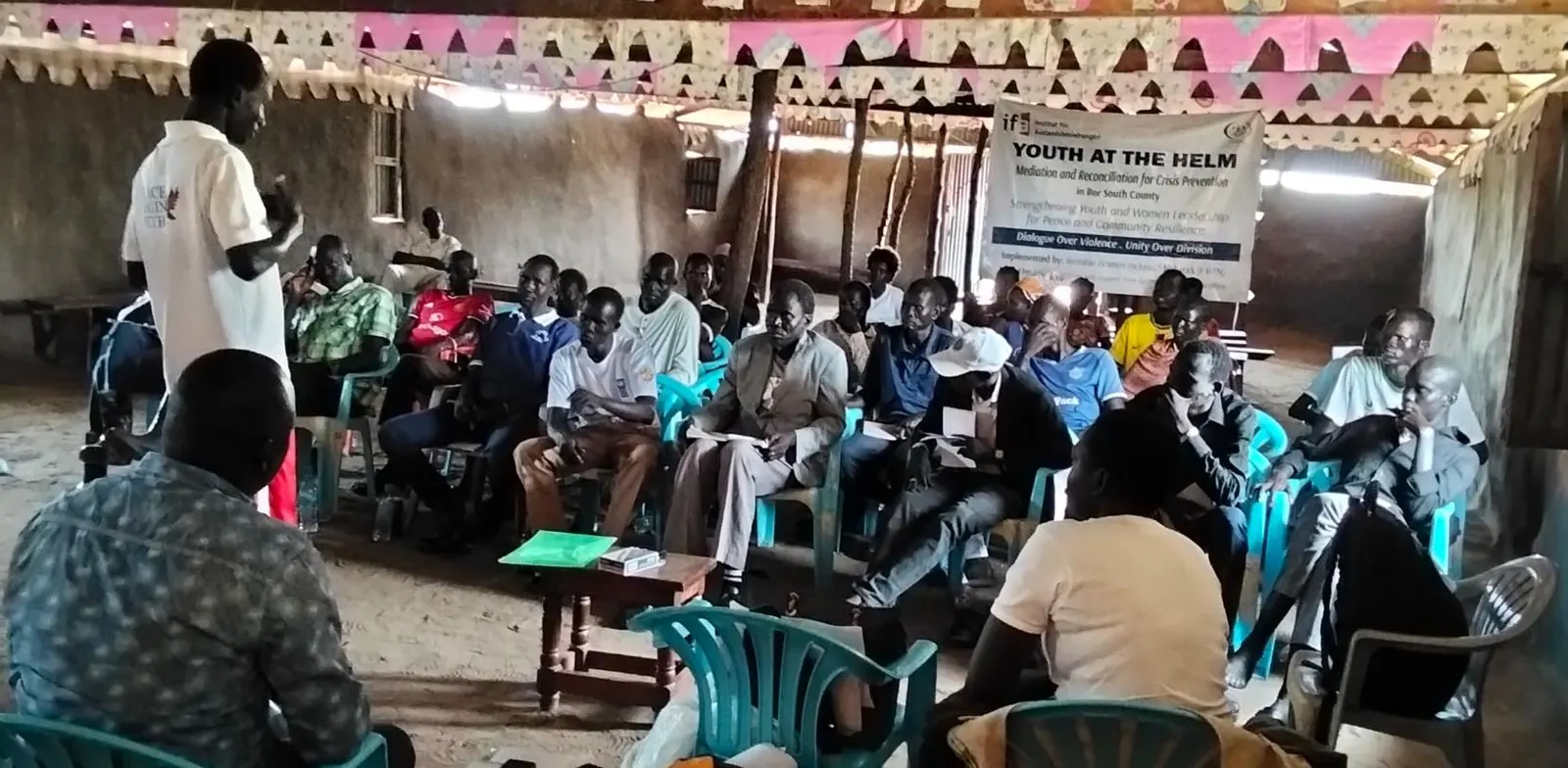
A major milestone was the successful training of eighty youth mediators drawn from the six target payams. The training was delivered through two intensive five-day sessions held in July 2026 and focused on mediation, trauma healing, conflict analysis, active listening, dialogue facilitation, counselling ethics, and peacebuilding approaches.

Participants gained practical skills for identifying root causes of conflict, facilitating dialogue between disputing groups, and promoting peaceful solutions within their communities. The training exceeded the project’s initial target for the reporting period and enabled the project to reach its full planned cohort of youth mediators much earlier than anticipated.

80

youth mediators trained

2 × five-day sessions

Eighty young mediators strengthened their skills in conflict prevention, mediation and reconciliation.

Establishing Peace Committees Across Six Payams

To strengthen local ownership of peace processes, community representatives from all six payams were mobilized to establish peace committees that will serve as local platforms for conflict monitoring, mediation, and early warning. Sixty community representatives participated in the consultations and helped define the committees’ responsibilities and operational structures.

Members discussed conflict identification, reporting systems, mediation responsibilities, and local approaches for promoting peaceful coexistence, while highlighting the need for continued capacity building in trauma healing, conflict documentation, and practical mediation skills.

60

community representatives engaged

in 6 payams

Community peace committees are laying the groundwork for stronger local conflict management and early warning systems.

Creating Opportunities for Inclusive Peacebuilding

The project places particular emphasis on the participation of women, youth, and historically underrepresented groups in peacebuilding. Deliberate efforts were made to improve community representation within peace committees and encourage broader participation in mediation and reconciliation activities.

Community sessions highlighted the importance of inclusive leadership in managing conflicts and ensuring peacebuilding structures reflect the diversity of local communities. As committees are formalized, further efforts will strengthen women’s participation and representation across local peace structures.

Inclusive participation strengthens the legitimacy and effectiveness of community peacebuilding mechanisms.

Preparing Communities for Sustainable Peace

One of the most significant findings from both the baseline assessment and the youth mediation training was the widespread recognition that conflicts over land use, grazing routes, and water access remain major risks to community stability. Participants consistently called for dialogue, peaceful negotiation, and stronger cooperation between communities.

The project is therefore positioning trained youth mediators and peace committees to lead dialogue and support future negotiations on resource access and communal coexistence, contributing to longer-term reconciliation across Bor South County.

Success story

Young People Leading Change

Young people are not only affected by conflict — they can lead the way in preventing violence and building reconciliation.

For many of the eighty youth mediators, the training represented their first formal opportunity to engage directly in community peacebuilding. Through the sessions, participants gained a deeper understanding of conflict drivers in their communities and developed practical skills to support dialogue and mediation processes.

Several participants emphasized that the training helped them recognize that youth are not only affected by conflict but can also become leaders in preventing violence and strengthening reconciliation. As the project progresses, these young mediators are expected to become important catalysts for peace across the six target payams.

Trained youth mediators are emerging as local champions for peace, dialogue, and reconciliation.

Looking ahead

What comes next

With the foundation now firmly established, the next phase will focus on transforming project outputs into visible community action. Peace committees will be formally constituted, mediation networks will become operational, and trained youth mediators will begin supporting conflict resolution initiatives within their communities.

The project will also facilitate community dialogue forums, leadership roundtables, radio programmes, peace caravans, and local negotiations around resource-based conflicts — strengthening relationships between communities, increasing trust in local peace structures, and creating sustainable pathways for preventing violence across Bor South County.

Empowering Youth. Preventing Conflict. Building Lasting Peace.

Project partners

Invisible Women Inclusion Network (I-WIN)
ifa (Institut für Auslandsbeziehungen e.V.) through the zivik Funding Programme
German Federal Foreign Office
Anyidi, Baidit, Bor Town, Jalle, Kolnyang and Makuach Payams, Bor South County, Jonglei State, South Sudan

Help us reach communities that are too often unseen.

Partner with I-WIN to protect women and girls, restore local environments and support young people building peace.